Zambia uses mainly type G sockets, the three rectangular-pin plug used in the UK, at 230 V and 50 Hz. You will also find type D (three large round pins, an older standard shared with parts of southern Africa and India) and occasionally type C (the two round-pin European plug). Bring a universal adapter that handles G, D and C and you will be covered in Livingstone, Victoria Falls town and most of the region.
Which adapter to bring
- From the UK or Ireland: your plugs fit type G sockets. Pack a type D adapter or a universal one for lodges with older wiring.
- From Europe: a G adapter is essential. Two-pin European plugs sometimes fit type C or loose type D sockets, but not reliably.
- From the US, Canada or Japan: you need an adapter for G and D, and you need to check the voltage of each device (see below).
- From South Africa: your type M plugs fit type D sockets in some places but not type G. A G adapter is needed.
- From Australia or New Zealand: you need a G and D adapter.
A multi-port USB charger with a type G plug cuts down the number of adapters you need, and it is handy when a tent or chalet has only one or two sockets by the bed.
Voltage: what works and what doesn't
Most modern electronics are dual voltage. Look at the small print on the charger: if it says "100–240 V, 50/60 Hz", it works in Zambia with just a plug adapter. This covers almost all phone, laptop, tablet and camera chargers.
Devices that are often single voltage (110–120 V only):
- Hairdryers, hair straighteners and curling tongs bought in North America.
- Electric shavers and toothbrush chargers, older models especially.
- Some CPAP machines (check yours; many are dual voltage).
Plugging a 110 V-only device into a 230 V socket will damage it. Either leave it at home or bring a step-down converter rated for its wattage. High-wattage converters are heavy; for a hairdryer, it is usually easier to use the one most lodges provide.
Neighbouring countries
If your trip continues beyond Livingstone:
- Zimbabwe (Victoria Falls town): types D and G, 220–240 V.
- Botswana (Chobe, Kasane): types D, G and M, 230 V.
- South Africa: types M and N, with older types D, 230 V. A universal adapter usually covers M but check it has the large round-pin option.
Power cuts
Zambia gets most of its electricity from hydropower at Kariba and Kafue. A severe drought in 2024 cut generation sharply and led to load shedding of up to 20 hours a day in parts of the country. In 2026 the national utility, ZESCO, said that new generation capacity and better rainfall meant it did not expect a return to nationwide load shedding. Local and unplanned outages still happen, especially during storms in the rainy season. Things can change with the next drought, so check recent news before you travel.
What this means in practice:
- Lodges usually have backup power: a generator, solar panels with batteries, or an inverter system. The changeover can take a few seconds to a minute. Some lodges run the generator only at certain times or limit what it powers; ask whether your room has power through an outage.
- Hotels in town generally have generators.
- ATMs and card machines can stop working in an outage. Carry some cash, as our guide to money in Zambia explains.
- Mobile networks can slow or drop when masts lose power. See SIM cards and Wi-Fi in Zambia.
- Restaurants may have a reduced menu during outages.
Power in tents and chalets
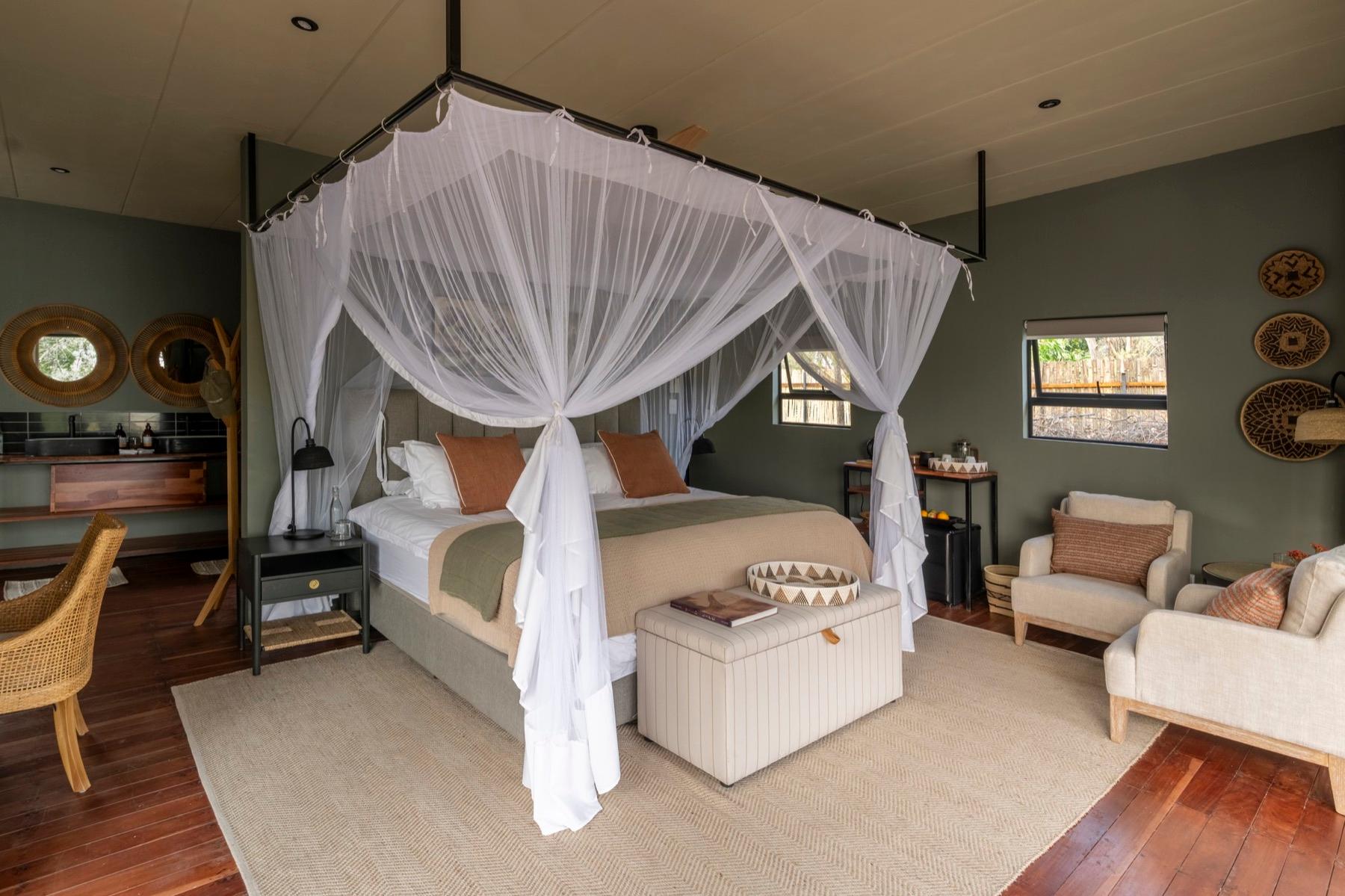
Luxury safari tents and chalets on the river generally have mains power and charging points, but sockets are fewer than in a city hotel and are not always where you want them. Some lodges on solar or inverter systems ask guests not to use high-wattage items such as hairdryers when running on batteries. If you are choosing between room types partly on comfort, the lodge can tell you how each is set up; Zambezi Dusk's accommodation page describes its tents, chalets and villa.
What to pack
- A universal adapter, or two if you are travelling as a couple.
- A multi-port USB charger, ideally with USB-C.
- A power bank of 10,000 to 20,000 mAh for long days at the falls, on the river or on a Chobe day trip. Airlines require power banks to go in cabin baggage, and some now limit their use on board.
- A head torch. Useful in an outage and for walking to your room after dark, where staff may also escort you.
- Spare camera batteries, charged before you head out each day.
Charging on the move
Transfer vehicles, safari vehicles and boats sometimes have USB points, but don't count on it. Charge everything overnight and carry the power bank. Photographers should read our Victoria Falls photography tips for more on kit and keeping it dry.