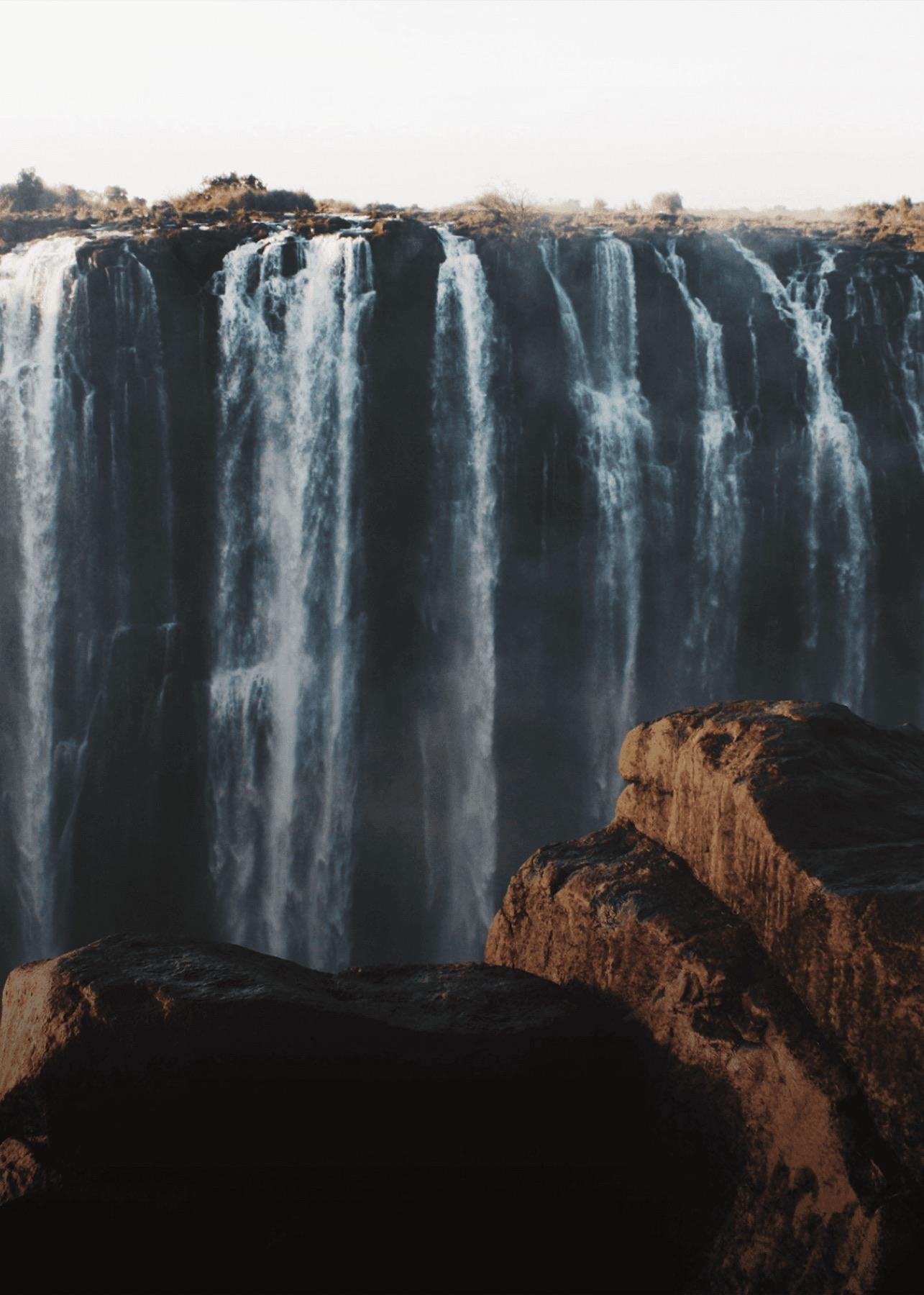
The lunar rainbow at Victoria Falls is a rainbow made by moonlight in the spray. You can see it on the nights around a full moon, when the moon is up, the sky is clear and the falls are throwing up enough spray, which usually means April to August. Both national parks open in the evening for three nights each full moon: the night before, the night itself and the night after.
How it works
A rainbow needs a light source behind you and water droplets in front. The full moon, rising in the east as the sun sets, lights the spray drifting up from the gorge, and a faint bow forms in the mist. It is only bright enough for a few nights a month, and only when there is a lot of spray to catch the light.
To the eye it is usually pale, white or silvery-grey with a hint of colour at the edges. Long-exposure photographs show the full spectrum, which is why online images look more vivid than what you see standing there. It is still a strange and memorable sight: a white arch hanging over a roaring black gorge.
Best months
| Months | Spray | Chance of a moonbow |
|---|---|---|
| January to February | Rising | Possible; cloud from the rains often blocks the moon |
| March to April | Peak flood | Spray so dense it can hide the bow and soak you through |
| May to August | High but easing | The best window: clear skies and plenty of spray |
| September to December | Low | Little or no spray on most of the falls; the bow is rare |
In a big flood year, April and May can be too wet to see much. In a dry year, the window may close by early August. Our page on the best time to visit Victoria Falls covers the flood cycle.
Coming full-moon dates
Full moons fall on roughly these dates (UTC; in Zambia and Zimbabwe, two hours ahead, the date can shift by a day). The viewing nights are the night before, the night of and the night after.
| Date | Notes |
|---|---|
| 24 November 2026 | Low water; unlikely |
| 24 December 2026 | Rains starting; unlikely |
| 22 January 2027 | Possible if clear |
| 20–21 February 2027 | Possible if clear |
| 22 March 2027 | Heavy spray |
| 20–21 April 2027 | Good if not too wet |
| 20 May 2027 | Good |
| 18–19 June 2027 | Good |
| 18 July 2027 | Good |
| 17 August 2027 | Good to fair |
| 15 September 2027 | Fair to poor |
Check an astronomical calendar for exact times, and the park's own announcements, since opening depends on the weather.
Zambian side
Mosi-oa-Tunya National Park opens its falls trails from about 18:00 to midnight on the three nights. You pay a night entry at the gate even if you visited during the day. The best spots are along the Knife-Edge Bridge and the paths facing the Eastern Cataract and Main Falls, where the spray is heaviest in high water. The park will not open if the weather is cloudy. Our guide to Mosi-oa-Tunya National Park covers the trails.
Zimbabwean side
Zimbabwe runs guided full-moon tours through the rainforest, usually as a group with a guide, timed for the moon to clear the trees. After the VAT changes in early 2026 the night viewing fee for international visitors was reported at US$116, with tour and transfer costs on top. You need entry to Zimbabwe, so check our KAZA UniVisa guide before booking a tour from Livingstone. The border posts close in the evening, so if you are staying in Zambia, a Zimbabwean night tour is only practical if you sleep in Victoria Falls town or the border hours allow your return.
What to wear and bring
- A full rain jacket and waterproof trousers in high water. You will be soaked otherwise, and it is surprisingly cold.
- A warm layer: June and July nights drop to around 10 °C.
- A head torch with a red-light setting for the paths. Keep it off when you are looking.
- Shoes with grip on wet rock.
- Insect repellent.
Photographing it
- A tripod is essential. Handheld shots will not work.
- Start around 15 to 30 seconds at f/2.8–f/4 and ISO 400–800, then adjust.
- Use a wide lens; the bow is large.
- Protect the camera: a rain cover or even a plastic bag with a hole for the lens. Wipe the front element between shots.
- Focus manually on a distant edge or a lit point.
More advice is in our page on photographing Victoria Falls.
Practicalities
Arrive soon after the gates open, before the moon is high, and give your eyes 15 minutes without a screen to adjust. Baboons and the odd elephant use the park at night, so stay on the paths. If you are staying upstream, for instance at Zambezi Dusk on the Kazungula Road about 30 minutes from the falls, ask in advance about transport for a night visit; the lodge arranges Victoria Falls visits through partners, but evening timings need planning.